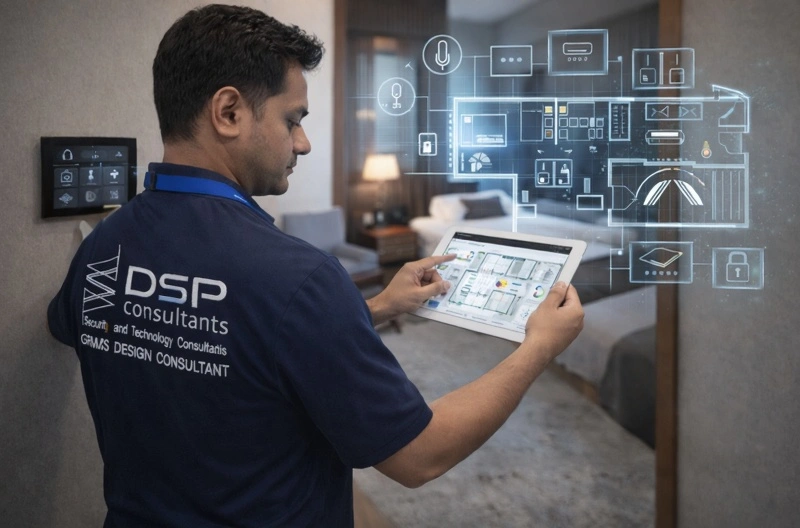
DSP Consultants have been consulting in the physical security industry for over 15 years now, we have consistently seen change in the industry. Stepping in the direction of development with the latest technology is one of the most crucial steps in the security industry.

Who are security consultants and what do they do?
Physical security consultants are security architects who do thorough analysis for your property identifying potential weaknesses, and creating security system design to minimize security threats. Based on their security audit they recommend customized security design which may include new security protocols for staff, changing the placement of already installed security cameras, or installing new cameras for better security posture, and more for your property.
DSP Consultants have been consulting in the physical security industry for over 15 years now, we have consistently seen change in the industry. Stepping in the direction of development with the latest technology is one of the most crucial steps in the security industry.
Physical security technology advancement has made it mandatory for us to depend on artificial intelligence.
Physical security is one of the first technologies that advanced into artificial intelligence and analytics and now with an AI revolution, the security industry is headed towards upgrades.
The core of artificial intelligence is data learning, which helps us recognize patterns and then predict the next steps.
Physical security is based on a similar foundation where patterns, movements, and surroundings are constantly monitored to understand data, and as soon as a pattern breaks, security systems are activated and alert the breach of security.
AI has transformed the way businesses approach physical security. Utilizing AI in security strategies has become a must to ensure the ultimate defense against threats.
Let us discuss some pros and cons of physical security from leading security consultants
Pros:
- Reduction of human error
Replacing security guards who would sit for hours to assess the ongoing video footage with artificial intelligence, security has taken a better shape. Because it reduces errors by assessing the activity or danger at the right time.
- Faster response to threat
Security guards who traditionally assessed the video footage and then sent a message to stop the incident or security breach were inefficient with time. With advanced AI-revolutionized systems, it is faster to get a response to any uncertain event, that further impacts the investment made in changing the security systems.
- Enhanced proactive monitoring
There is more to AI advanced security than just warning of security intrusion, in today’s world physical security has advanced into tracking and guiding toward necessary actions.
A few examples of this would be :
- Updating vacant parking spaces for ease of traffic management
- Object recognition to help secure the surroundings
- Face recognition to help track forfeitures
Cons:
- Data security risks
As we are monitored by computers and machines our data and personal information is subject to cybersecurity threats, we can be prepared for it but can not mitigate it completely.
- Limitations of our knowledge of AI
Artificial intelligence has been around for a decade now evolving from time to time, it has helped in the development of technology but still remains unknown to us as it can have malfunction and errors that can cause bigger damages than anticipated.
- Machine Learning Errors
AI Models are complex like a black box, it’s difficult to understand how machine learning takes place and reaches its final decisions. This lack of transparency can cause errors that can not be unlearned or reverted by the machine unless reset.
In conclusion, physical security is advancing with technology, and in the years to come it will evolve for even better results. Physical security is not only important for safety and security but also provides faster solutions to day-to-day problems.
We at DSP Consultants began our business journey as security consultants and have been evolving with new technological advances and industry trends.
To learn more about our journey, projects, services, and more please contact us at