What are environmental sounds?
Environmental sounds are sounds that surround us in the space that we occupy. Environmental sound examples are the usually low-level sound of leaves rustling in the wind or traffic noise from a distance.
What is considered environmental noise?
Environmental noise is defined as an unwanted loud sound in an environment that can interfere with normal activities such as sleep, conversation, or concentration and cause negative health effects. Environmental noise is also called noise pollution. We all occupy our own space which is surrounded by other objects, beings, and sounds. Sounds are born from all objects, beings, and even air. Every element in our surroundings has the potential to contribute to the soundscape, whether passively or actively, called environmental sound.
Environmental noise on the other hand is an unpleasant or unwanted sound that negatively impacts a person’s mind and body. An example of environmental noise and its impact is below.
You see a picture below which explains with the help of an example, a common issue that might occur in many different households. Our environmental noise consultants resolve noise issues by conducting an acoustic study of the premises and suggesting the best noise control and mitigation solutions for our clients.

As acoustical consultants, we identify the source of noise and suggest an accurate solution to minimize or completely mitigate the noise and its impact on your surroundings.
As a leading environmental noise consultant we have provided our services to different hospitality and development projects around KSA. We partner with architects, lead consultants, developers, and engineers to achieve the perfect balance of sound in the environment
Steps involved in doing an acoustic study for our client’s
1. Site assessment:
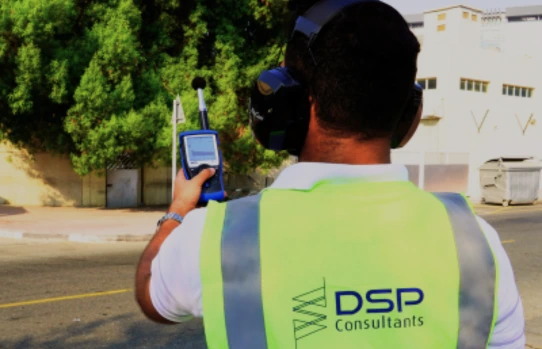
This stage is the first stage of acoustic assessment which takes place on site where we identify existing and potential noise sources that can disrupt day-to-day activities. Noise sources involve traffic noise, nearby industry noises, natural elements like wind and water, etc.
2. Noise Impact Assessment:
Once the on-site noise study is completed our experts then conduct a noise impact assessment or NIA. An NIA is a comprehensive study that helps to propose the effect of noise from and on the project. For example in a mixed-use development or residential project we evaluate the impact of noise for the construction period on the neighbors and area and after the completion on impact of noise on the inmates keeping in mind the local noise regulations.
3. Acoustic Design and Mitigation Strategy:
Depending on the assessments our acoustic consultants collaborate to create detailed designs and strategies to guide architects and engineers this further includes steps such as:
A) Building design adjustments: such as specifying the sound insulating materials to be installed, and designing buffer zones such as open spaces, and courtyards to reduce noise exposures.
B) Noise Barriers: Suggest physical barriers like walls, acoustic fencing, or berms to protect the development from external noise.
C) Soundproofing Measures: Recommending materials for soundproofing windows, doors, and insulation materials inside the development to optimize noise impact.
D) HVAC And Mechanical Systems: Ensuring that heaters, air exhaustion, and air conditioning systems are designed to minimize operational noise.
4. Regulatory Compliance
Environmental noise consultants ensure that the project is aligned with all necessary regulations. For example hospitality industry has a set of industry-specific standards and rules for guest comfort ensuring noise levels are within acceptable limits.
5. Construction Noise Management
During the construction phase, noise consultants implement noise management plans to optimize the effect of noise created by construction on nearby residents and businesses. For example, advising on quieter machinery and monitoring noise levels during the ongoing construction.
6. Final Stage Evaluation
After the project is completed our experts conduct a post-construction monitoring to analyze if there are any gaps and help correct errors if any.
Environmental noise consultants are essential in ensuring project completion by carefully assessing, designing, and managing noise, we are experts at creating environments that are both welcoming and comfortable.
Typical Environmental Noise Scenarios
• Sound-level limits for a new development
• Environmental impact of a large infrastructure
project, such as malls, residential developments, resorts, etc
• Development of commercial-use buildings in a residential area.
• Development of major transportation routes like metro lines in underground
Typical noise sources
• Alert devices (horns/traffic noise)
• Amusement parks
• Building services equipment (MEP)
• Concert venues
• Construction and tunneling activity
• Industrial operations
• Power generation (such as power plants for building large projects)
• Ventilation fans
• Transportation
• Aircraft (airports)
• Highways
• Trains
• Shipping (ports)
• Occupational noise
• Power tools
We provide environmental noise assessment consultation for all different kinds of projects in Saudi Arabia followed by the regulations of the government. Please contact us at info@dsp-cosnultants.com to inquire about your project.
Ready to Build your perfect noise environment
for maximum productivity